Nov 18, 2025
4 min read
"How To Fund Your Startup and Achieve Product Market Fit Before Taking VC" - Daniel Theobald

Daniel Theobald challenges the standard Silicon Valley approach that pushes founders to quickly build pitch decks, seek VC funding, and aim for billion-dollar exits. He asserts that most successful businesses never took venture capital, and VC kills more businesses than it helps. The speech offers a pragmatic, founder-focused alternative:
Key Takeaways and Insights
1. Model Building and Founder Mindset
All advice—even from investors—should be taken skeptically. Founders must develop their own world model and decision-making framework. You, as the founder, live with your business and think about it 24/7, unlike any investor.
Models are mental simplifications; all are wrong, but some are useful. The founder’s superpower is the ability to predict the future better than anyone else—by constantly learning, updating, and improving their mental model.
Ego is a major obstacle; humility, continuous learning, and iterative improvement are critical.
2. VC Funding is High Risk and Often Damaging
“Taking VC is like pressing the self-destruct button.” Once VC is involved, you have limited time to “kill the alien” (reach success) before the business is doomed by dilution, control loss, and conflicting interests.
Only 1 in 4 startups return any capital to VCs, and the average return is dismal (22 cents per dollar for male-led, 44 cents for female-led companies).
Your interests, the company’s interests, and investors’ interests diverge rapidly as soon as money and success are at stake. Founders must protect their own interests and equity.
3. How Should You Fund Your Startup?
Best Option: Be independently wealthy—not realistic for most.
Second Best Option: Fund your business through real customers. Revenue from customers is “ground truth”; investors and VCs are not.
Other Options: Small business loans, bootstrapping, government grants, and product crowdfunding are valid but carry trade-offs and risks. Raising from friends/family is usually not advisable.
Accelerators/Incubators often offer little real value and take significant equity.
4. Product Market Fit and Growth
Don’t rush into scaling. Early startups should have as few customers as possible—focusing on genuinely solving problems and learning deeply.
When true product-market fit arrives and unit economics make sense, then scaling can happen organically—without rapid dilution or dangerous growth fueled by VC.
Avoid “hiring/firing for the sake of it” and other hype metrics (like post-dotcom valuation by employee count).
5. Control and Liquidity
Maintain control. Never lose board control, as this usually leads to being ousted and losing the company you built.
As soon as investors are involved, liquidity for founders dries up; you can no longer pay yourself out of the business freely.
Most personal financial success stories come from bootstrapped, customer-funded businesses.
6. Mental Health and Founder Resilience
Founders face significant mental health challenges; 82% report serious issues and 75% have severe loneliness.
Sleep, exercise, nutrition, and community are vital for founder health and resilience.
Failure is not only acceptable but commendable. Failing fast, pivoting, and starting over is a healthy and proven path to eventual success.
Don’t be normal—embrace your unique perspective, superpowers, and sometimes even “flaws” (obsession, anxiety, difference) that may give you an edge.
Substance abuse is a major risk for founders under stress. Healthy coping and support networks are necessary.
7. Practical Closing Advice
Build real businesses solving real problems for real customers.
Scale slowly; don’t succumb to “window of opportunity” hype, fast-scaling mania, or pre-revenue valuation games.
Know your goals—whether for financial success, learning, or fun. Don’t let vanity or peer pressure dictate your path.
Make all decisions (especially around fundraising and scaling) with detailed awareness of trade-offs: time, effort, control, mental costs, and actual risks, not just surface-level promises or hype.
8. Final Personal Recommendation
“If I could go back and do it again, I would never take VC.” Personal financial success and satisfaction stem from customer-funded businesses and maintaining as much control and liquidity as possible.
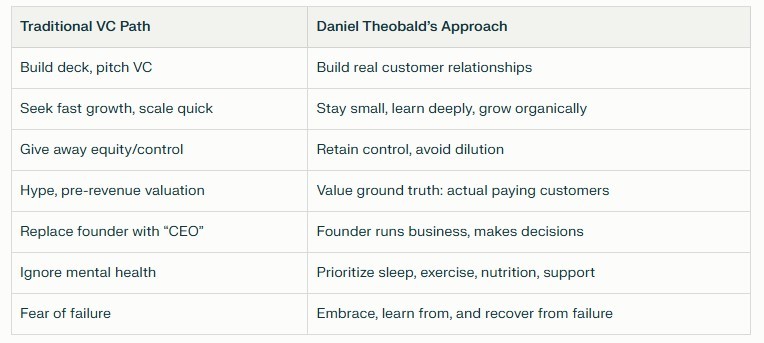
Summary Table: Traditional VC Playbook vs. Daniel Theobald’s Approach
Program Structures and Investment Models
Most Important Takeaway:
Fund your startup through your customers, maintain control, learn fast, and put your personal and mental health first. VC is just one tool, and usually not the best one—use with extreme caution.